manyeyes v1.1.2
Many independent reviewers. One ranked list.
A swarm of AI code reviewers, Codex and Claude, reads your change. You get one list, ranked by how many of them found each problem.
Open source · Apache-2.0
2–3 min per review Every real issue kept 0 invented findings
What it does
A review team in one command.
-
Independent reviewers
Codex and Claude read your change in parallel. Each one reads it alone.
-
Each in its own sandbox
A bubblewrap jail per reviewer. It sees the change and its login, never your secrets.
-
Ranked by agreement
One synthesis. What several reviewers found on their own comes first.
-
Three modes
Quick while you iterate, full by default, deep for a risky change.
-
Related repos, read-only
Up to 5 per review, to catch a change that breaks a caller in another repo.
-
Self-hosted, with MCP
An MCP endpoint for coding agents, a REST API and a web UI.
-
Per-person limits New
For a shared server: limits per person, and a fair queue so others go first.
-
Plan usage New
How much of the Codex and Claude plans is used, and when each window resets.
Results
Every real issue kept. Nothing invented.
A blind judge checked every finding against the code. Codex and Claude each catch severe bugs that the other misses, so a full review runs both.
- Real issues dropped by the synthesis
- 0
- Checked by a blind judge
- Invented findings
- 0
- Checked by a blind judge
- Independent reviewers in a full review
- 10
- 8 Codex and 2 Claude, each in its own sandbox
- Median full review
- 2.7 min
- About 9 ranked findings each
How it works
Agreement is the signal.
Ten reviewers that each read the code alone find more than one reviewer that reads it ten times. Where several flag the same line on their own, the finding is usually real.
-
01
Your change
A clean copy of the change. Ignored files, such as
.env, never reach a reviewer. -
02
Ten reviewers, each in a jail
By default 8 Codex and 2 Claude. Each one sees only the change and its own login.
-
03
One ranked list
gpt-6.1-sol merges every review. Findings that both families agree on come first.
The web UI
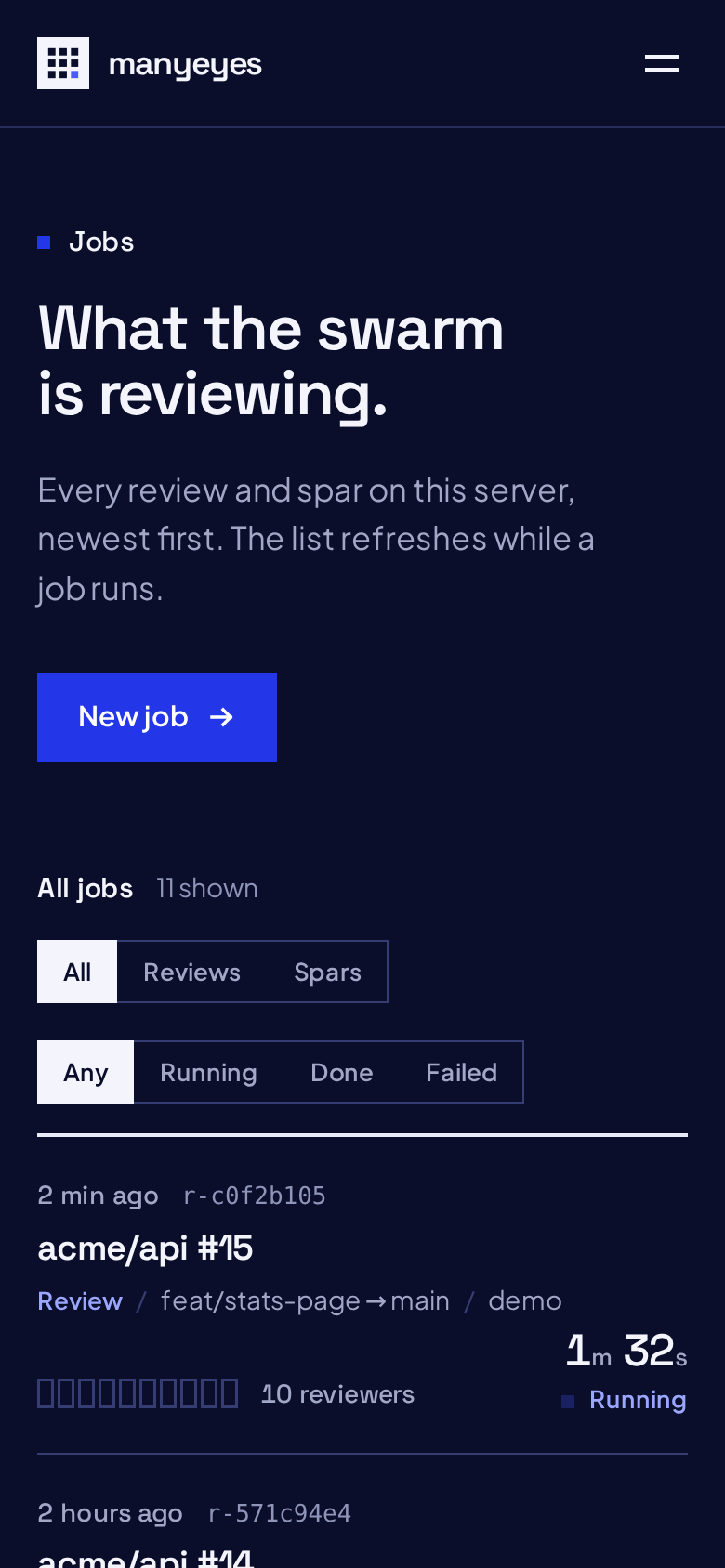
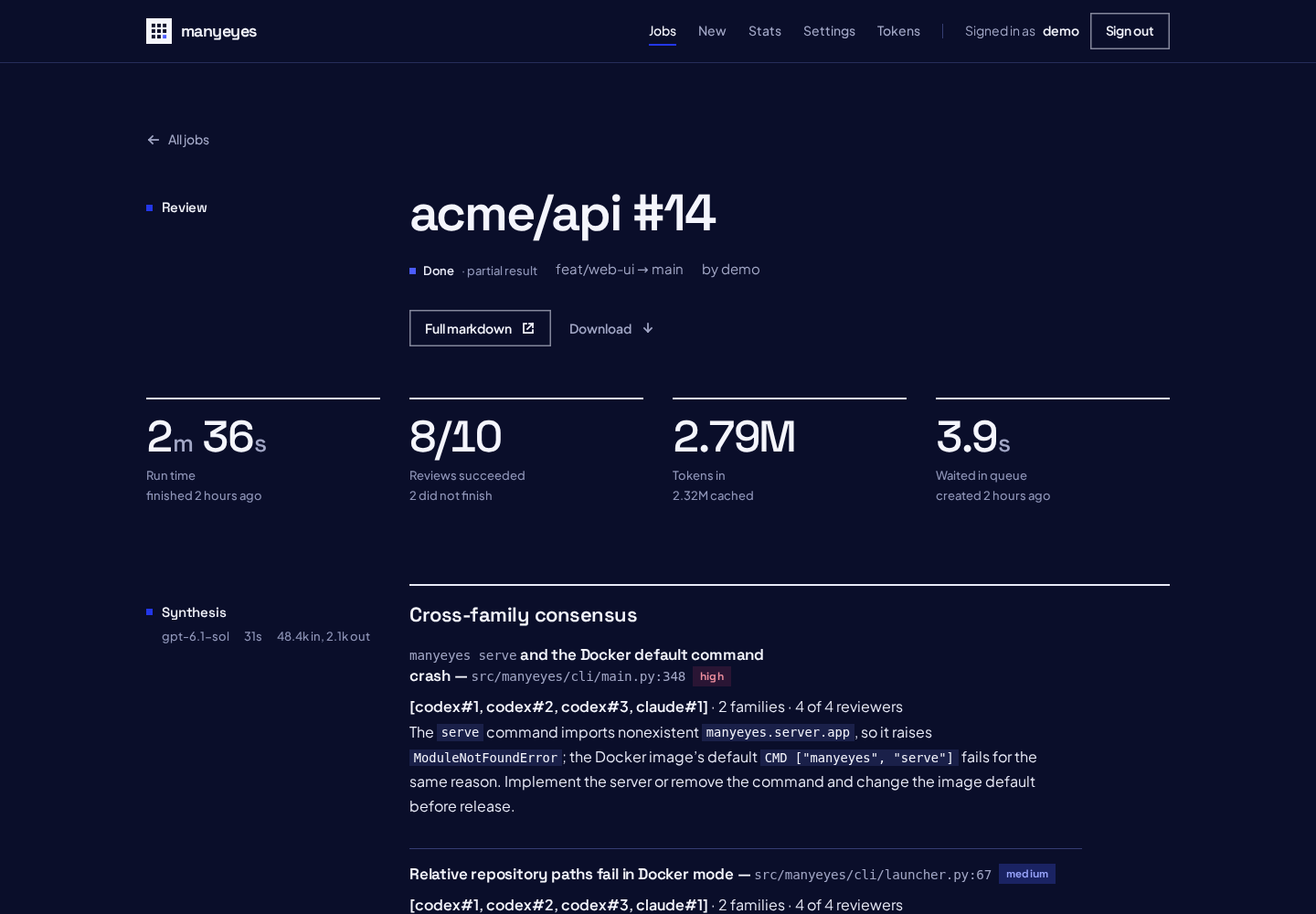
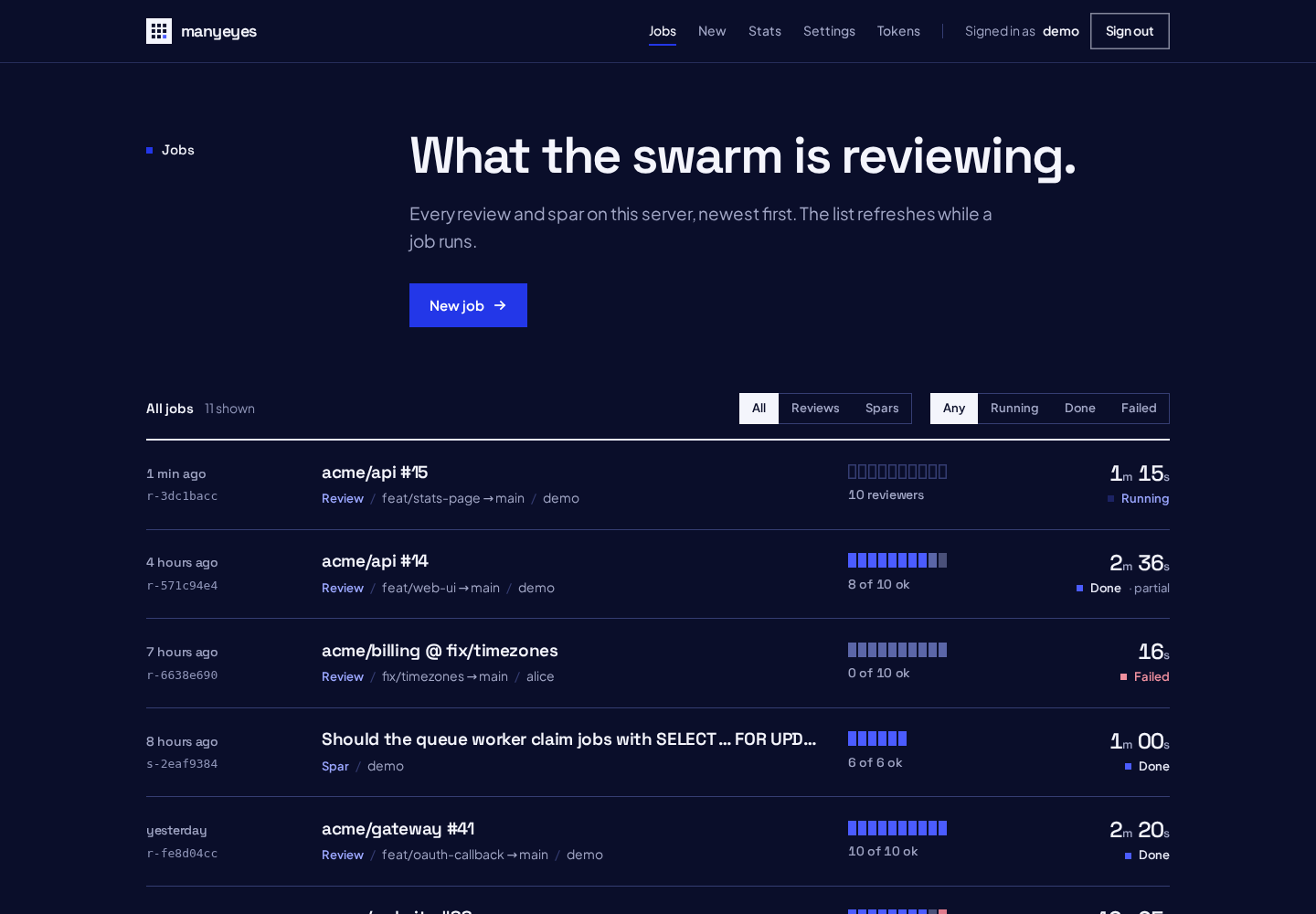
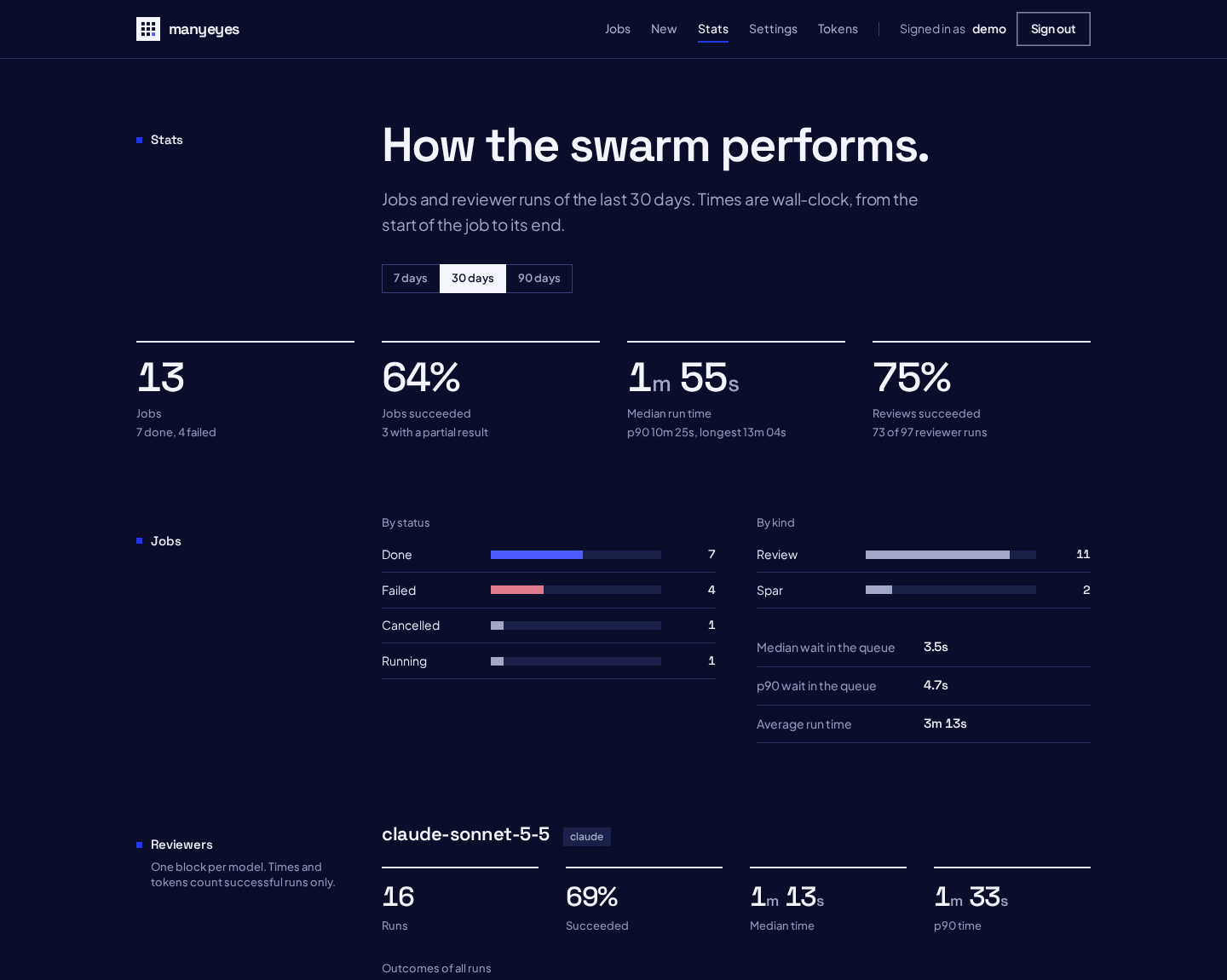
Watch the swarm work.
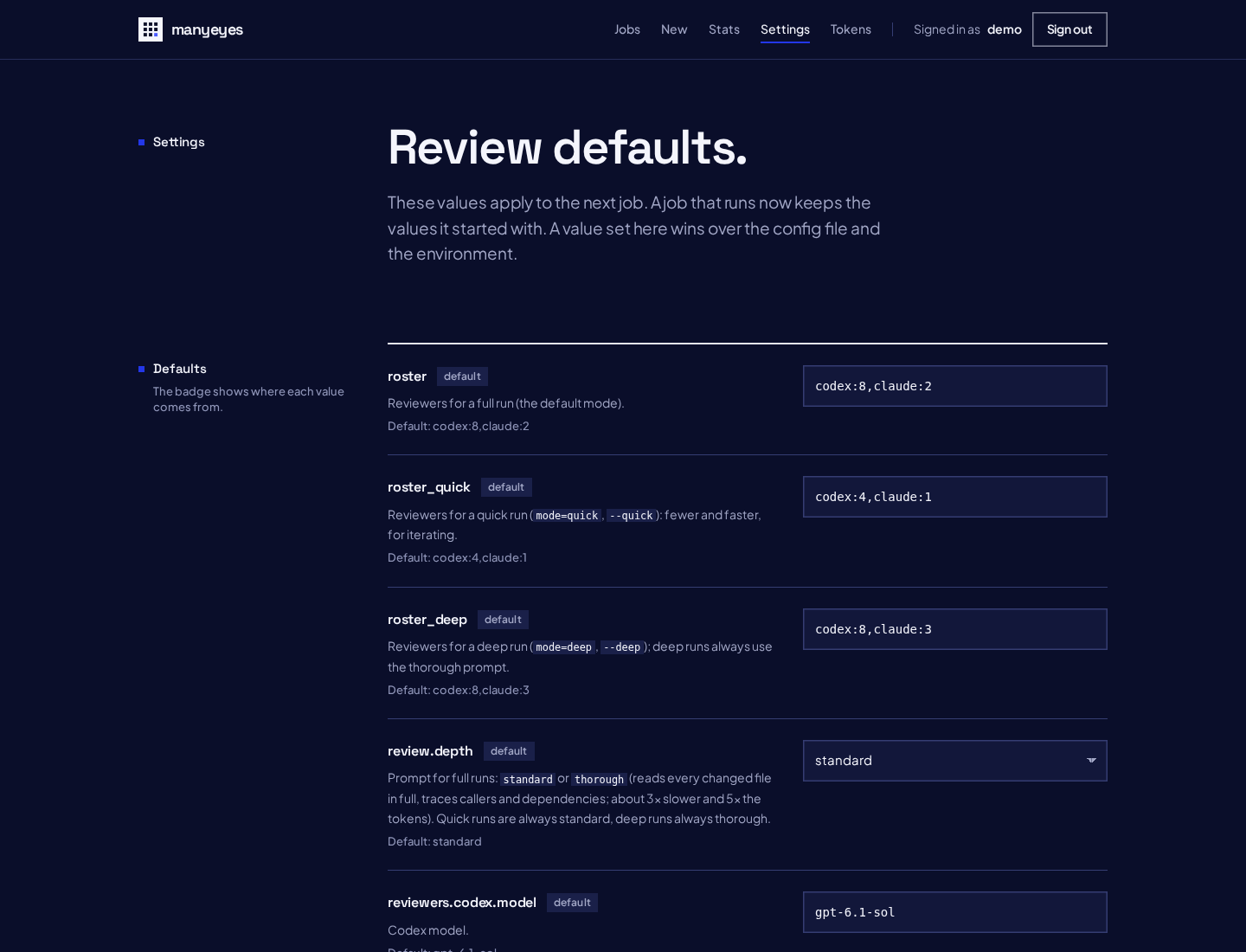
Jobs with live progress, every review in full, the defaults and the stats. Light or dark, on a laptop or a phone.
Two ways to use it
From the terminal, or from your coding agent.
Command line
In any git repository. It needs Docker and your reviewer logins, no server.
# install, and sign in to a revieweruv tool install git+https://github.com/Masboes/[email protected]manyeyes login codex# in any git repositorymanyeyes reviewmanyeyes: job r-571c94e4: your-repo, 10 reviewers (codex:8,claude:2)manyeyes: [10/10] claude#2 ok 2m21smanyeyes: synthesis done in 31s## Cross-family consensus### Relative repo paths fail in Docker mode: medium[codex#1, codex#2, codex#3, claude#1] · 2 families# about a minute, while you iteratemanyeyes review --quick# a risky change, with a related repomanyeyes review --deep --context acme/web
uv tool install git+https://github.com/Masboes/[email protected]
manyeyes login codex
manyeyes review
manyeyes review --quick
manyeyes review --deep --context acme/web
Server and MCP
Self-hosted, for a team. Coding agents call it over MCP, people use the web UI. Self-hosting guide
# connect Claude Code to a manyeyes serverclaude mcp add --transport http manyeyes https://manyeyes.example.com/mcp# the agent then calls swarm_review, and gets the# ranked synthesis back in the same turn
claude mcp add --transport http manyeyes https://manyeyes.example.com/mcp Status
Version 1.1.2, open source.
manyeyes is the successor of the swarm, and it already runs in production. Install the CLI in one command, or run your own server for a team.
Open source · Apache-2.0